
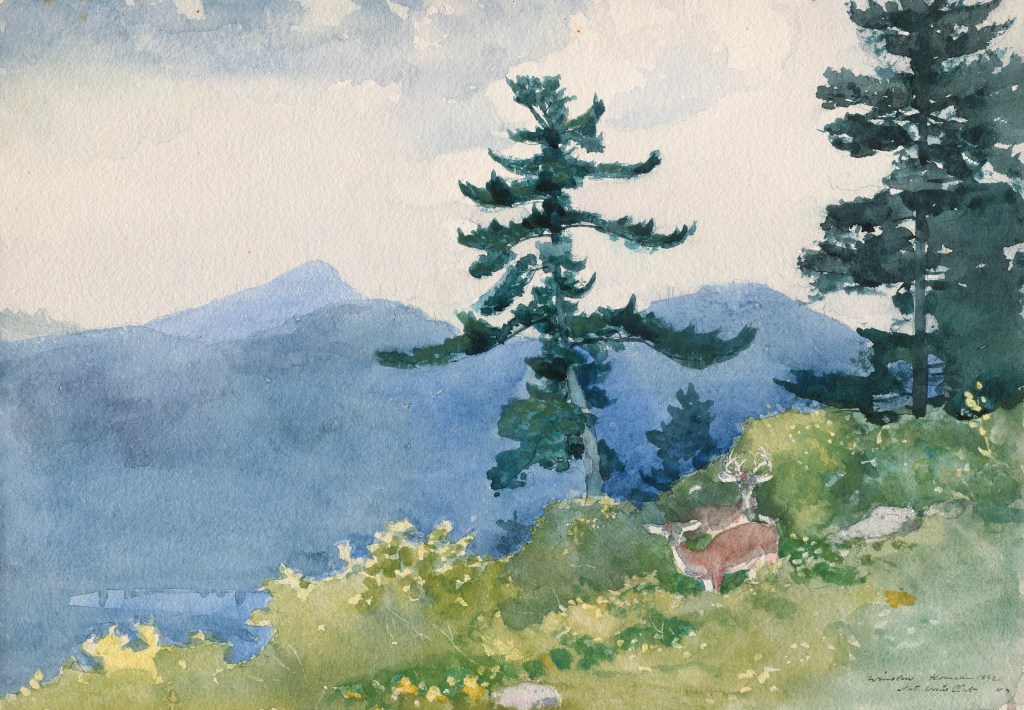
There’s something almost cinematic about the moment Winslow Homer captured in his 1892 watercolor “North Woods Club, Adirondacks .” Picture yourself standing at the edge of a mountain meadow, watching two white-tailed deer freeze mid-conversation, their heads turned toward an unseen presence. That split second of awareness, of danger perhaps, hangs in the air like morning mist.
Homer had a gift for finding poetry in tension. Here, in this deceptively peaceful Adirondack scene, he’s painted far more than just deer in a meadow. The title alone hints at drama. A tête-à-tête interrupted suggests intimacy broken, peace disturbed. But by what? Homer leaves that question tantalizingly unanswered, letting our imaginations fill the void.
The technical mastery on display here takes my breath away every time I study it. Homer worked with watercolor like a jazz musician improvises, rewetting areas, blotting and scraping to create textures that make you want to reach out and touch the paper. The yellow-green flowering meadow practically glows against those cool purple-blue mountains in the distance. It’s a color harmony that shouldn’t work but absolutely sings.
What strikes me most powerfully is Homer’s environmental consciousness, decades before it became fashionable. Those two towering white pines standing sentinel in the composition aren’t just compositional elements. They’re silent witnesses to destruction. By 1892, white pine forests in the Adirondacks were being decimated by logging operations. Homer painted these trees with the same careful attention he gave the deer, making sure both threatened species would be unmistakably recognizable to viewers.
This parallel between the pines and the deer reveals Homer’s sophisticated understanding of interconnected ecological systems. The hunting controversy in the Adirondacks wasn’t just about sport versus conservation. It was about humanity’s relationship with wilderness itself. Homer navigated these politically charged waters with the subtlety of a diplomat, never preaching but always suggesting.
I love how Homer built this painting. He drew everything in careful pencil first, establishing the precise anatomy of both deer and the distinctive needle clusters of the white pines. Then came the watercolor magic. Those mountains didn’t just happen. Homer understood how atmosphere behaves in mountain country, how distant peaks take on that ethereal blue-purple hue that makes them seem to float.
The composition itself tells a story about vulnerability. These deer exist in a liminal space, caught between the safety of the forest and the openness of the meadow. It’s a metaphor that resonates beyond wildlife. We’ve all felt that moment of exposure, of suddenly realizing we’re being watched.
Homer spent his later years increasingly focused on nature’s power and fragility. This Adirondack period produced some of his most environmentally conscious work, though he rarely made his politics explicit. Instead, he let beauty speak for itself, trusting viewers to understand the deeper implications.
The painting’s current status as “off view” at the Art Institute of Chicago makes it feel even more precious, more elusive. Like the deer themselves, it exists in that space between seen and unseen, available and protected. Perhaps that’s fitting for a work that deals so eloquently with the tension between preservation and access.
What moves me most about this watercolor is its quiet urgency. Homer painted it knowing that both the deer and the pines were under threat, yet he chose to show them in a moment of perfect, fragile beauty. There’s something profoundly hopeful in that choice. Even in the face of environmental destruction, beauty persists. Art preserves what we might otherwise lose.
Standing before Homer’s Adirondack watercolors, whether in person or through high-quality digital reproductions, you can almost hear the silence of that interrupted conversation. It’s the kind of moment that changes how you see wilderness forever.
For those inspired to bring this timeless moment into their own spaces, quality digital prints can capture much of Homer’s luminous color work and delicate technique. There’s something wonderful about living with great art, letting it speak to you daily about the precious fragility of our natural world.
 Ngoluoc.vn
Leave a comment