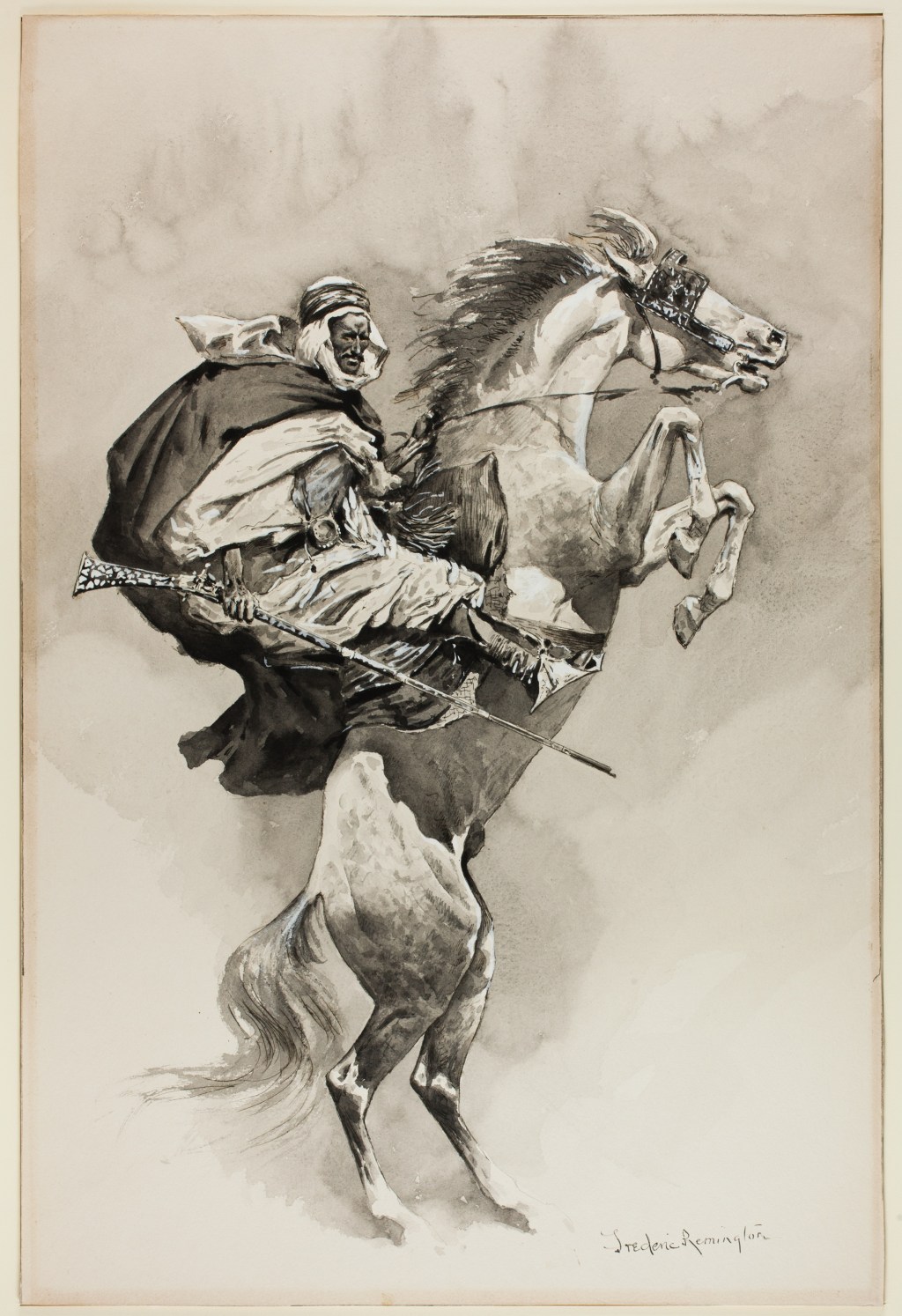
Picture this: the most celebrated painter of the American West, suddenly transported to the windswept deserts of Arabia. Sounds impossible, right? Well, Frederic Remington made it happen in 1894 with “As They Threw their Animals Back upon their Haunches,” and honestly, it’s one of those artworks that makes you do a double take.
I’ve spent countless hours studying Remington’s cowboys and cavalry charges, but this piece? It stopped me in my tracks. Here’s an artist who built his entire reputation on dusty saloons and buffalo hunts, suddenly capturing the exotic mystery of Arabian horsemen with the same visceral energy that made his Western scenes legendary.
The composition itself is pure theatrical drama. These aren’t your typical Wild West riders. Instead, Remington presents us with Arabian horsemen in a moment of sudden halt, their mounts rearing back with that characteristic grace that only comes from centuries of desert breeding. The way he captures the tension in both horse and rider speaks to his deep understanding of equestrian dynamics, regardless of geography.
What strikes me most is Remington’s technique here. Working with brush and black gray wash heightened with white gouache over graphite, he creates this luminous quality that feels almost otherworldly. The cream laminate board adds warmth to the entire piece, making those white highlights pop like desert moonlight. It’s sophisticated work that shows just how versatile this artist truly was.
The historical context makes this piece even more fascinating. In 1894, America was obsessed with Orientalist themes. Harper’s New Monthly Magazine was feeding public appetite for exotic adventures, and publishers knew that anything “Arabian” would sell magazines. But Remington wasn’t just jumping on a trend. He was genuinely exploring how his artistic voice could translate across cultures.
I imagine him in his studio, probably surrounded by reference materials and photographs from Middle Eastern expeditions. The challenge must have been immense. How do you capture the essence of a culture you’ve never directly experienced while staying true to your artistic vision? Remington solved this by focusing on what he knew best: the relationship between humans and horses in moments of high drama.
The storytelling here is subtle but powerful. That phrase “threw their animals back upon their haunches” suggests urgency, perhaps danger approaching or a sudden obstacle discovered. These riders aren’t leisurely traveling; they’re responding to something immediate and potentially threatening. Remington understood that the best illustrations don’t just decorate a story, they become essential to understanding it.
From a technical standpoint, the piece demonstrates Remington’s evolution as an artist. By 1894, he had moved beyond simple illustration into something approaching fine art. The composition is carefully balanced, with negative space used as effectively as the detailed figures. The contrast between light and shadow creates depth that draws you into the scene.
What I find particularly compelling is how this work bridges two worlds. It has all the dynamic energy of Remington’s Western scenes but filtered through an entirely different cultural lens. The horses move with Arabian elegance rather than mustang wildness. The riders carry themselves with desert dignity rather than frontier pragmatism.
This illustration also represents a pivotal moment in American art history. As the frontier was officially declared closed in 1890, artists like Remington were forced to look beyond the West for inspiration. Some went to Europe; Remington went to Arabia, at least in imagination.
For modern viewers, this piece offers something rare: a glimpse of how one of America’s most distinctly American artists interpreted the wider world. It’s Remington unleashed from geographic constraints, showing us that great artists don’t just document their immediate surroundings but can transport us anywhere their imagination leads.
If you’re drawn to this unique intersection of American artistry and Arabian mystique, you’ll find that high quality digital prints can bring this desert drama right into your own space, letting you experience Remington’s cross-cultural masterpiece whenever inspiration calls.
 Ngoluoc.vn
Leave a comment