
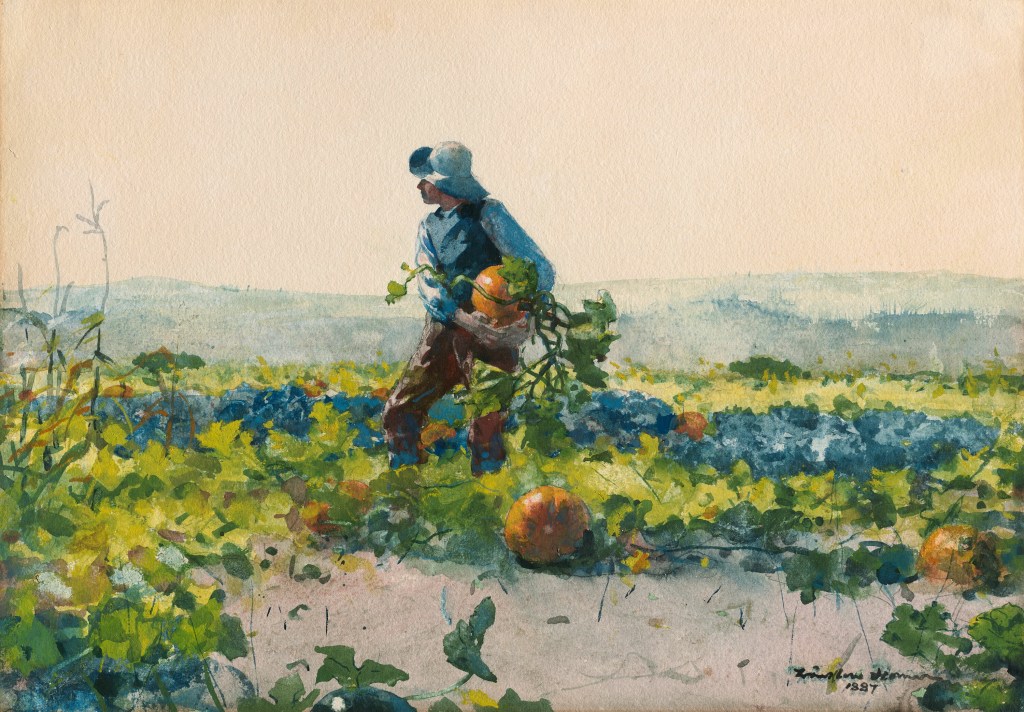
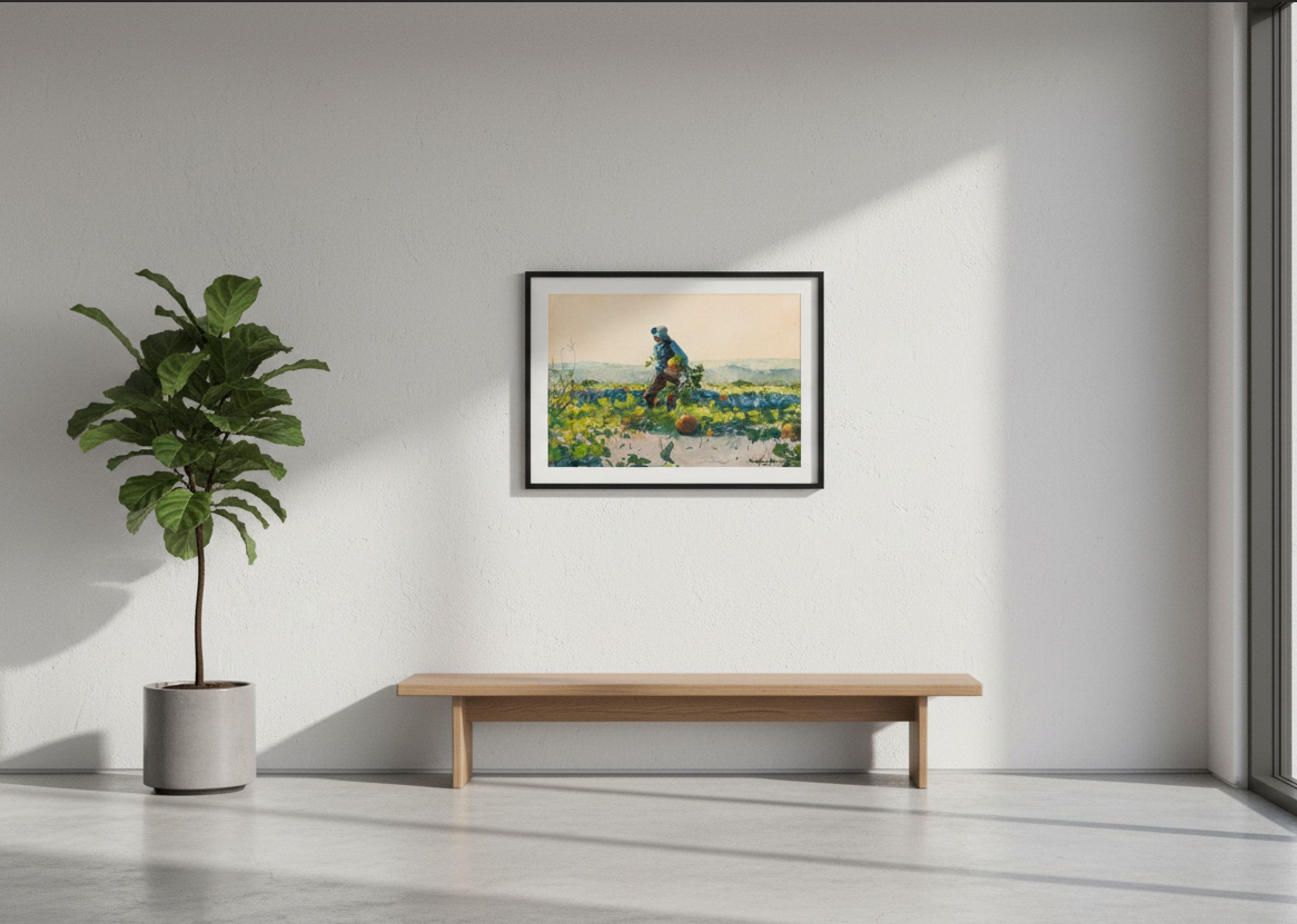
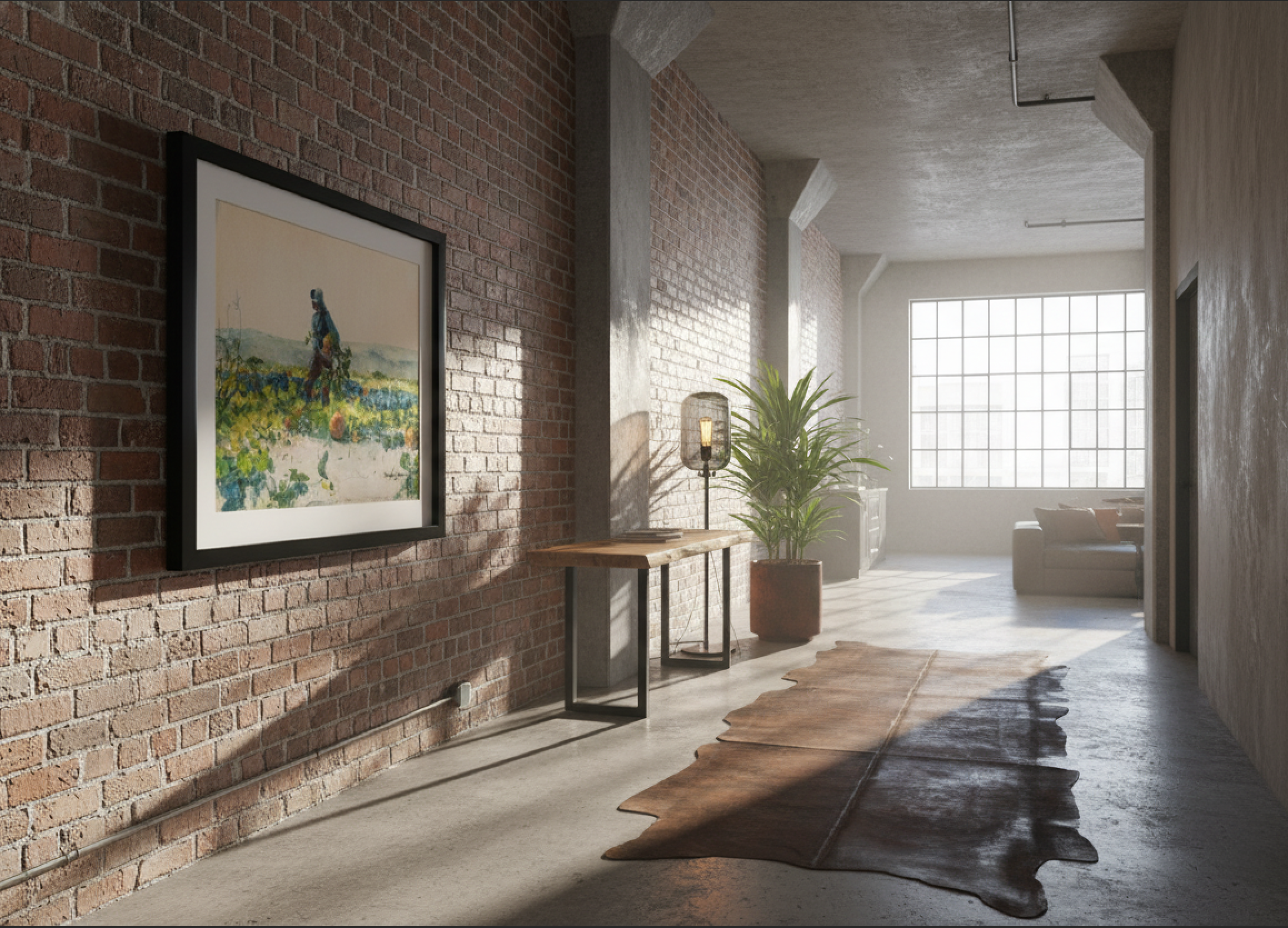
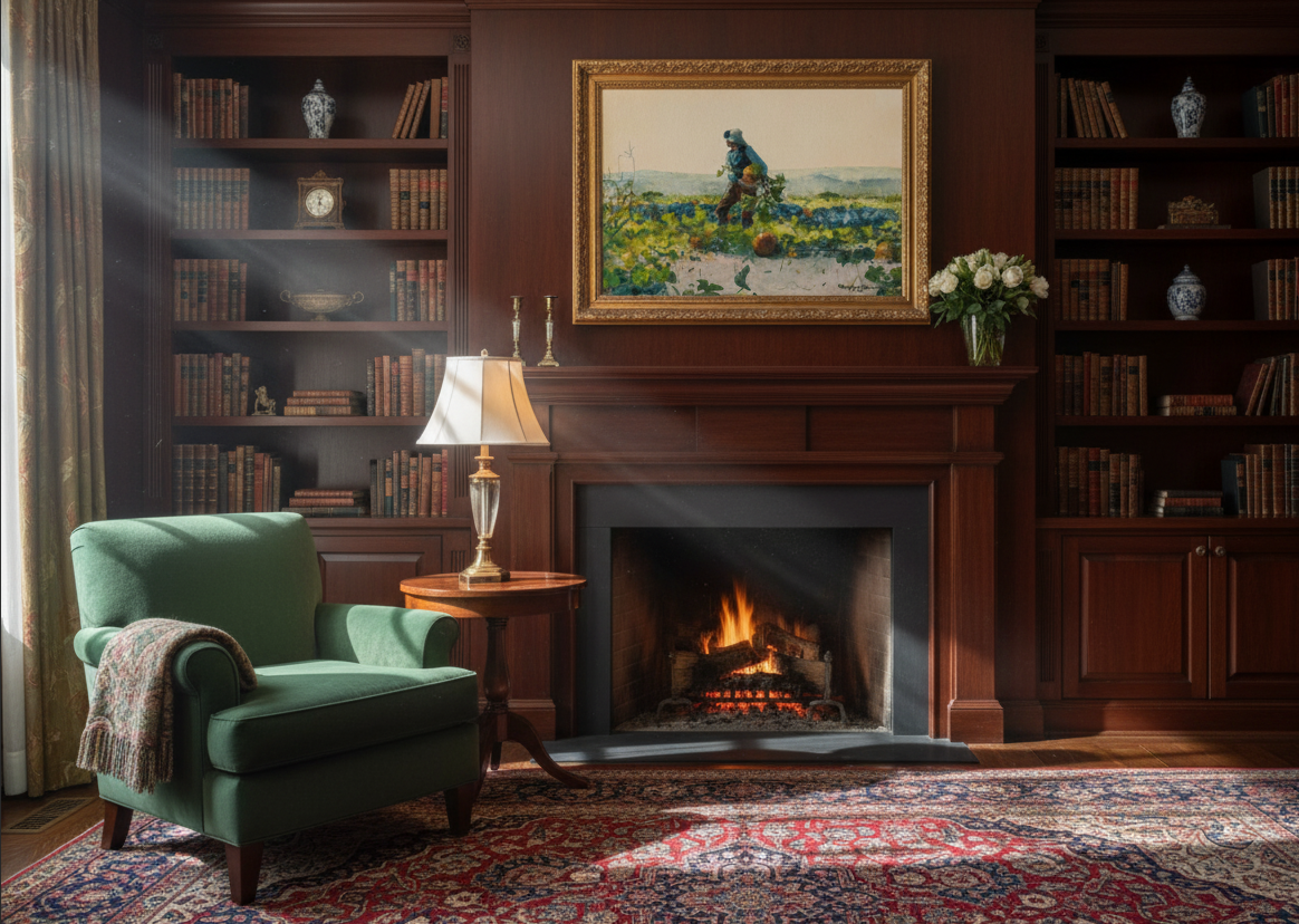
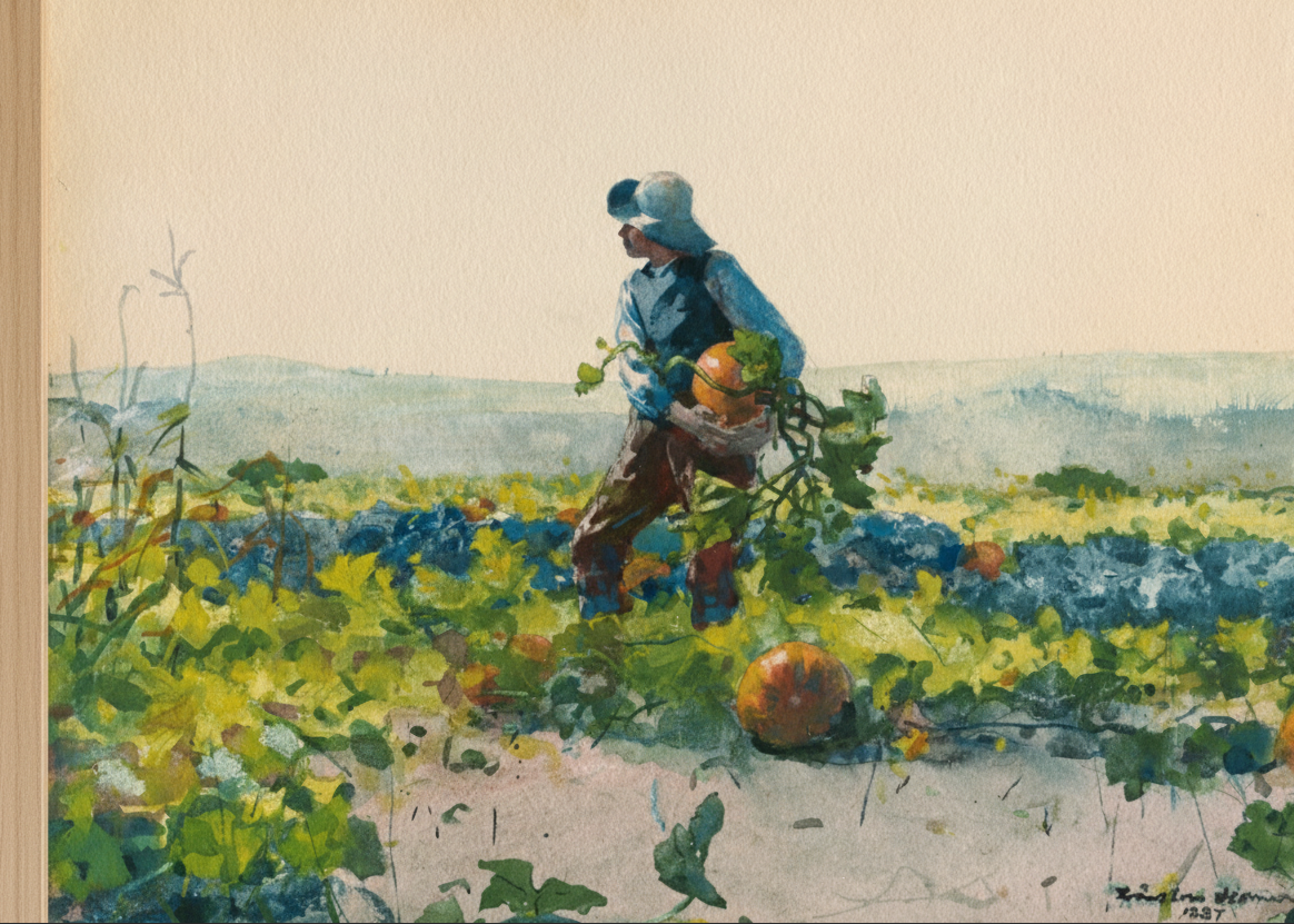
There’s a quiet nostalgia running through Winslow Homer’s For to Be a Farmer’s Boy. Painted in 1887 at his beloved Prout’s Neck studio in Maine, this watercolor revisits one of his favorite themes — rural childhood in America. A young boy pauses amid the harvest, surrounded by golden fields and scattered pumpkins, gazing softly toward what was once a radiant sunset.
Though the sky has faded over time, scientific studies have revealed traces of chrome yellow and pink madder pigments — proof that Homer originally painted a glowing orange sky. That lost warmth would have bathed the scene in evening light, turning the boy’s pause into a poetic moment between day’s labor and night’s rest.
The painting’s title comes from an old English folk song — “Though little, I’ll work as hard as a Turk, if you’ll give me employ, to plow and sow, and reap and mow, and be a farmer’s boy.” It’s a song about endurance and honest labor, values that deeply resonated with Homer throughout his career. The choice of verse, and the quiet dignity of the boy’s pose, reveal the artist’s lifelong respect for working people and the rhythm of simple rural life.
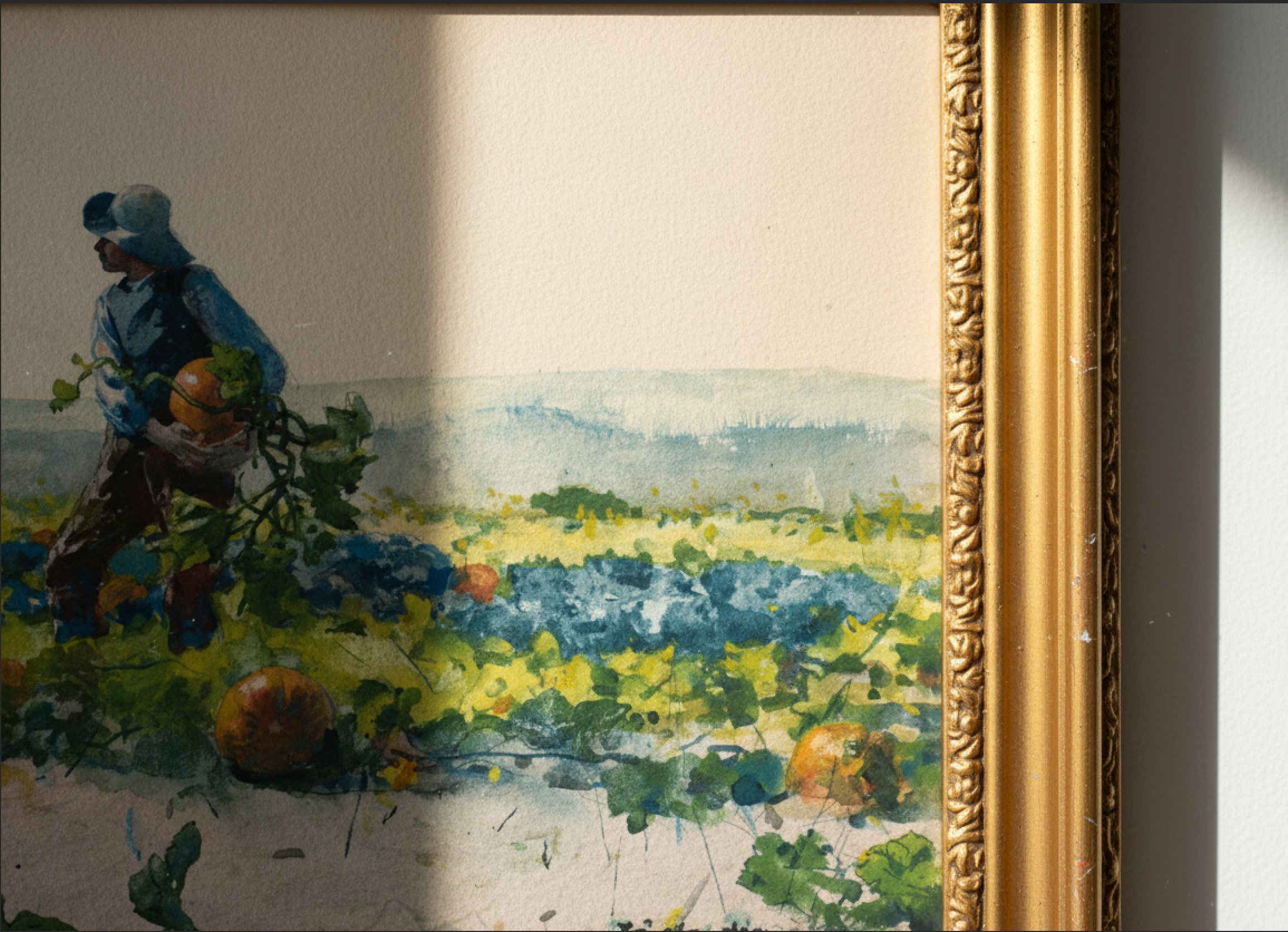
In For to Be a Farmer’s Boy, Homer combines technical mastery with emotional restraint. His watercolor technique — layering transparent and opaque washes, blotting and rewetting, even scraping the paper — creates texture and depth that feel almost tangible. The rough ivory paper gives the image a grounded warmth, perfectly suited to the earthy subject.
Homer had long admired the French Barbizon painters, who depicted peasants resting at day’s end. This influence lingers here, not just in theme, but in mood. The boy’s stillness feels contemplative, as if he’s caught between work and wonder, effort and dream. It’s that human pause — the breath after effort — that makes Homer’s rural scenes so moving.
There’s a tenderness in this painting that feels timeless. You don’t just see a farm boy; you see a symbol of resilience, humility, and the quiet poetry of labor. Even now, more than a century later, For to Be a Farmer’s Boy glows with that same humanity — soft, sincere, and golden as an autumn sunset.
If you’d like to explore Winslow Homer’s classic American watercolors in fine digital reproductions, visit The Pelican Atelier through the ~Linktree here~ . Each print is a gentle echo of Homer’s devotion to light, labor, and the beauty of everyday life.
*
Có một nỗi hoài niệm ấm áp len lỏi trong For to Be a Farmer’s Boy của Winslow Homer. Được vẽ năm 1887 tại xưởng vẽ của ông ở Prout’s Neck, Maine, bức tranh màu nước này quay lại đề tài quen thuộc mà ông luôn yêu mến – tuổi thơ nơi nông thôn nước Mỹ. Một cậu bé dừng tay giữa cánh đồng thu hoạch, xung quanh là những quả bí ngô và ánh vàng của cỏ khô, đôi mắt lặng nhìn về phía hoàng hôn xa.
Mặc dù bầu trời trong tranh nay đã phai, các nhà nghiên cứu bằng công nghệ quang phổ đã tìm thấy dấu vết của màu vàng crôm và hồng madder chứng tỏ Homer từng vẽ một bầu trời rực cam ấm áp. Ánh sáng ấy từng bao phủ cả cảnh đồng, khiến khoảnh khắc nghỉ ngơi của cậu bé trở nên thơ mộng, giữa ranh giới của lao động và yên bình.
Tên bức tranh được lấy từ một bài hát dân gian Anh cổ: “Though little, I’ll work as hard as a Turk, if you’ll give me employ, to plow and sow, and reap and mow, and be a farmer’s boy.” (Dù nhỏ bé, tôi vẫn làm việc chăm chỉ, nếu cho tôi cơ hội, để cày, gieo, gặt hái, và trở thành một người nông dân.) Lời ca ấy nói về sự bền bỉ, cần mẫn – những giá trị mà Homer luôn trân trọng và thể hiện trong nghệ thuật của mình.
Trong For to Be a Farmer’s Boy, Homer kết hợp kỹ thuật tinh tế với cảm xúc tiết chế. Ông sử dụng các lớp màu trong và đục, thấm lại, cạo đi, và tạo hiệu ứng nhấn sáng bằng chất keo trong suốt. Tất cả cùng tạo nên bề mặt sống động, chân thực như chính làn da và mùi đất.
Ảnh hưởng từ các họa sĩ trường phái Barbizon những người từng khắc họa cảnh nông dân nghỉ ngơi sau một ngày dài – vẫn hiện rõ trong tranh Homer. Cậu bé ấy không chỉ dừng lại để nghỉ, mà dường như đang mơ mộng, đang nghĩ về điều gì xa xăm hơn cả cánh đồng trước mặt.
Có một sự dịu dàng bền lâu trong bức tranh này. Bạn không chỉ thấy một cậu bé nhà nông, mà còn thấy biểu tượng của lao động, của sự khiêm nhường và vẻ đẹp giản dị trong cuộc sống. Hơn một thế kỷ trôi qua, For to Be a Farmer’s Boy vẫn tỏa sáng bằng thứ ánh sáng nhân văn ấm áp – như hoàng hôn trên đồng mùa gặt.
Việc Homer ký tên tác phẩm này hai lần, chữ ký thứ hai được vẽ đè lên chữ ký đầu, cho thấy ông coi nó đặc biệt quan trọng. Có lẽ ông cảm nhận được rằng khung cảnh đơn giản này về một cậu bé và hoàng hôn của mình sẽ vang vọng qua các thế hệ, ngay cả khi chính những màu sắc bắt đầu phai dần thành ký ức.
 Ngoluoc.vn
Leave a comment