
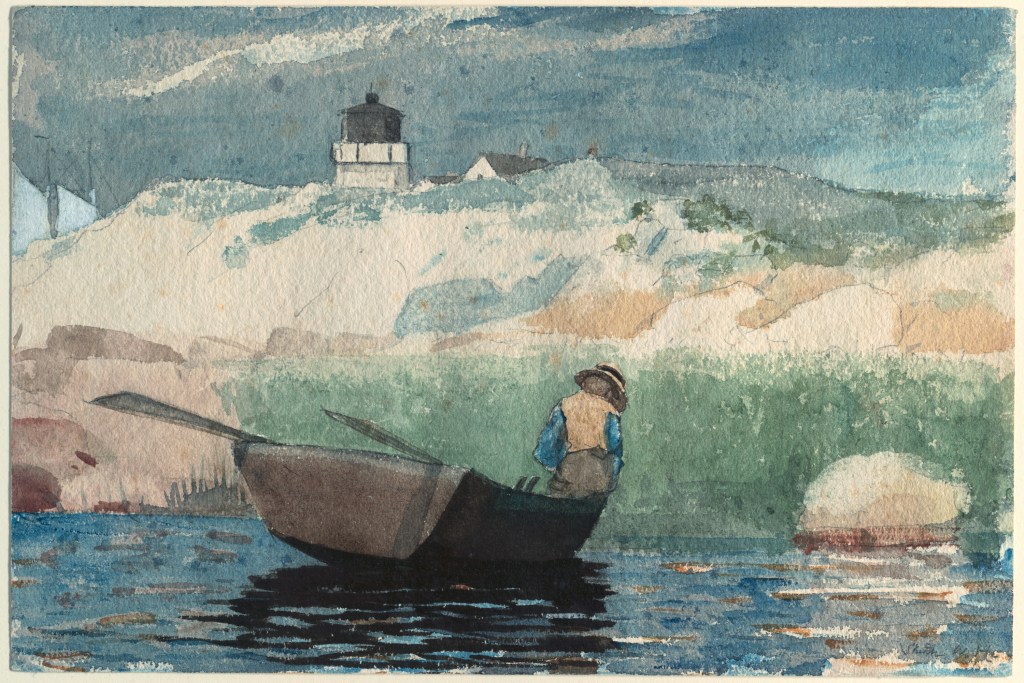
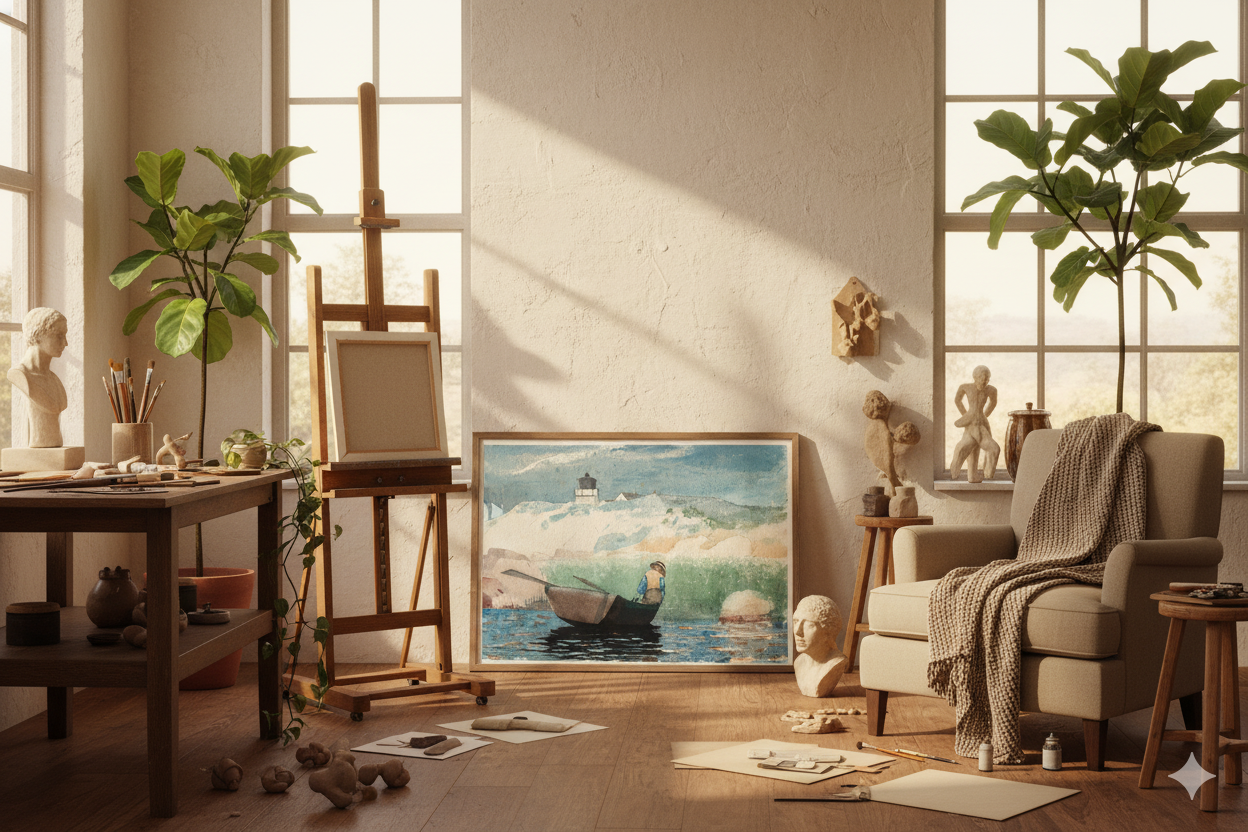
There’s something magical about watching a child alone with the vast ocean, isn’t there? Winslow Homer captured that exact moment in his 1880 watercolor “Boy in Boat, Gloucester,” and every time I look at it, I’m transported to that salty Massachusetts harbor where time seems to pause between childhood and the calling of the sea.
Picture this: Homer is staying at the lighthouse on Ten Pound Island, probably waking each morning to the sound of fishing boats heading out before dawn. The year is 1880, and America is still finding its artistic voice. Homer, at 44, has already made his mark with Civil War illustrations and oil paintings, but here in Gloucester, something different is stirring in his artistic soul. He’s falling in love with watercolor, and more importantly, he’s discovering the poetry in everyday coastal life.
The boy in this painting sits quietly in his small boat, perhaps waiting for his father’s return from the fishing grounds. Homer had a particular gift for observing these local children, the sons of fishermen who grew up knowing the rhythm of tides and the weight of waiting. These weren’t posed portraits but glimpses of authentic life, caught with an artist’s eye that understood both the innocence of youth and the serious business of surviving by the sea.
What strikes me most about this piece is Homer’s technical experimentation. You can actually see him learning, pushing boundaries. Notice how he scrapes away paint to reveal the white paper underneath, creating those brilliant highlights on the large rock. It’s a technique that would become one of his signatures, but here it feels fresh, almost hesitant. The transparent watercolors he uses for the water’s surface create this gorgeous sense of depth and movement. You can practically feel the gentle lapping of waves against the boat’s hull.
The composition is deceptively simple yet masterfully balanced. The boy, small against the enormous rock formation, speaks to themes Homer would explore throughout his career: humanity’s relationship with nature, the courage required for life by the sea, and the quiet dignity of working people. There’s no drama here, no storm or rescue scene. Instead, Homer gives us something more profound: a moment of perfect stillness that contains multitudes.
I love how the artist signed this one simply “W.H. sketch” in graphite. Even Homer seemed to recognize this as a study, a moment of discovery rather than a finished masterpiece. Yet that’s precisely what makes it so compelling. We’re witnessing an artist at work, experimenting with new techniques and finding his voice in a medium that would eventually make him America’s greatest watercolorist.
The cultural context matters too. This was painted during America’s Gilded Age, when industrial progress was reshaping the nation. But Homer consistently looked away from urban sophistication toward simpler, more authentic ways of life. Gloucester represented something pure: honest work, connection to nature, and communities where children still learned life’s lessons from the sea itself.
Looking at this painting today, I’m struck by its timeless quality. That boy could be any child, anywhere, learning patience and solitude while surrounded by nature’s grandeur. Homer understood something essential about childhood that many artists miss: sometimes the most profound moments are the quiet ones, when a young person sits alone with their thoughts and dreams.
The technical aspects continue to amaze me. Homer’s handling of light reflecting off water, the subtle gradations in the sky, and the solid presence of that dramatic rock formation all demonstrate why he became such an influential figure in American art. This wasn’t just observation; it was interpretation, poetry made visible through pigment and paper.
For anyone drawn to Homer’s masterful blend of technical skill and emotional resonance, our carefully curated collection of digital prints allows you to bring these timeless American scenes into your own space. There’s something special about living with art that captures both a specific moment in history and universal human experiences.
“Boy in Boat, Gloucester” reminds us that great art often emerges from patient observation of ordinary life. Homer found the extraordinary in a simple scene of a boy waiting by the water, and in doing so, created a window into both his own artistic development and the enduring relationship between American life and the sea that shapes it.





 Ngoluoc.vn
Leave a comment