

Among the many grand canvases of nineteenth-century French military painting, few rival the energy and pathos of Édouard Detaille’s The Charge of the Cuirassiers at Reichshoffen. Painted after the Franco-Prussian War of 1870, this vast composition captures one of the most dramatic yet tragic moments of French military history: the doomed but heroic charge of the heavy cavalry at the Battle of Reichshoffen.
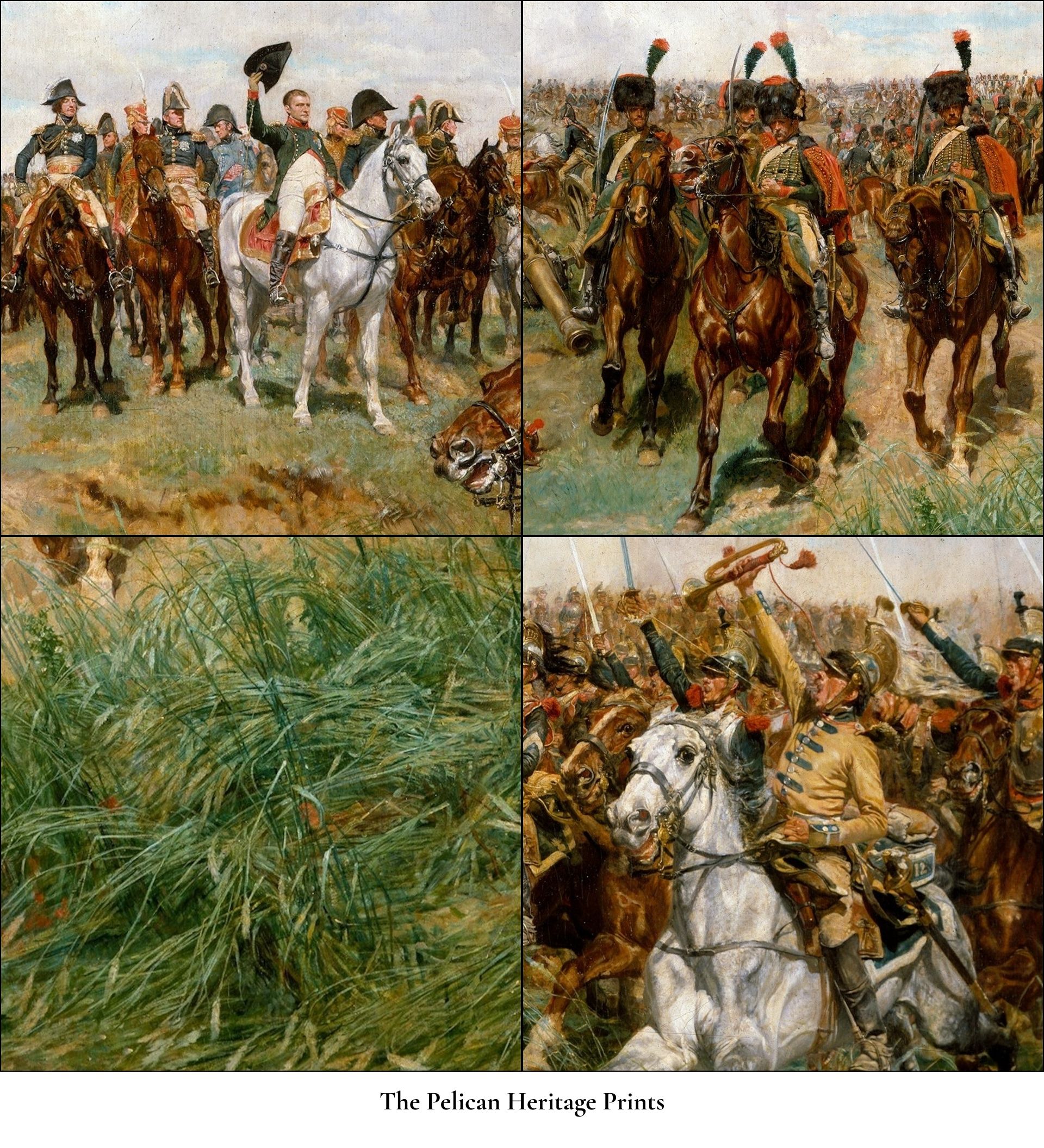
At first glance, the canvas overwhelms with movement. Horses rear and leap forward, sabers flash in the sunlight, and the ground is torn apart by hooves. To the right, a wave of cuirassiers surges into the fray, their armor glinting with a brilliance that borders on theatrical. To the left, order and composure hold their ground: Napoleon III and his officers appear as figures of calm command, seemingly untouched by the storm.
The composition thus stages a dialogue between chaos and order. The cavalrymen embody unbridled energy, while the central commanders act as pillars of stability. This duality heightens the dramatic tension, reminding the viewer that war is both discipline and frenzy.
Detaille’s cuirassiers are not simply soldiers. They are symbols of French martial pride, heirs of a knightly tradition that stretched back centuries. Their polished armor, crested helmets, and massive horses are painted with such precision that the work could serve as a textbook of uniforms. Yet beyond detail, there is symbolism: these men represent an ideal of courage, honor, and sacrifice.
The Battle of Reichshoffen ended in disaster for France, with the cuirassiers suffering terrible losses. By immortalizing their charge, Detaille transformed tragedy into legend. He allowed the French public to remember not the defeat, but the valor.
One of the painting’s most striking features is its use of light. The gleam of steel, the play of sunlight on helmets, the sheen of horseflesh — all combine to create a visual symphony. The sky, bright with patches of blue and drifting clouds, offers a deceptive serenity above the tumult. At the foreground, grasses are flattened by the rush of cavalry, anchoring the viewer in the physical immediacy of the charge.
Detaille’s palette balances earthy greens and browns with the metallic brilliance of silver and the vibrant accents of red plumes. The effect is both realistic and theatrical, giving the charge an almost operatic grandeur.
Critics have often accused Detaille of idealizing war. Indeed, there is little blood or carnage here. The chaos of combat is transformed into beauty, almost choreography. Yet this was precisely his intention. As an artist working in the aftermath of national humiliation, Detaille sought not to dwell on defeat but to elevate memory.
By focusing on courage rather than suffering, he gave the French people a way to reclaim pride. The Charge at Reichshoffen is thus less a literal report than a cultural monument, turning loss into legend.
Detaille was renowned for his almost obsessive accuracy. He studied uniforms, weapons, and equipment with scholarly rigor. Every strap, plume, and stirrup in the painting is rendered with fidelity. Yet what distinguishes him is his ability to fuse detail with vitality. The painting never feels static or overburdened. Instead, the meticulous observation fuels the illusion of movement.
The viewer feels the vibration of hooves, the clash of steel, the collective shout of men spurring forward. In this sense, Detaille’s work is both document and drama, at once history and theater.
At the center-left of the canvas stands Napoleon III, calm and elevated. His mere gesture — raising his hat — seems to orchestrate the entire scene. Though history records his reign ending in defeat, in Detaille’s vision he becomes the conductor of a martial symphony, the axis around which chaos organizes itself.
This symbolic role elevates Napoleon beyond politics. He becomes a timeless figure of command, embodying the continuity of French leadership even in moments of catastrophe.
Standing before this painting, one cannot help but be swept up by its force. The eye darts between the furious charge on the right and the poised command at the center. The ear almost hears the clash, the shout, the pounding of hooves. And the heart feels both admiration and melancholy — admiration for the bravery, melancholy for the inevitable loss.
It is this duality that makes The Charge of the Cuirassiers at Reichshoffen so powerful. It is both triumph and tragedy, both reality and ideal. It shows us war not as it is, but as a nation wished to remember it.
Édouard Detaille’s Charge of the Cuirassiers at Reichshoffen is more than a painting of a battle. It is a monument to courage, a balm for wounded pride, and a testament to the power of art to shape memory.
Through masterful composition, dazzling light, and unflinching detail, Detaille transformed a moment of loss into a vision of grandeur. His cuirassiers gallop not merely into combat, but into legend. And as long as this canvas endures, the thunder of their charge will continue to echo in our imagination.



 Ngoluoc.vn
Leave a comment